

A big pharmacy chain is ringing alarm bells, saying a bill in the Tennessee legislature could shutter 134 of its pharmacies across the state. But lawmakers on both sides of the aisle are accusing the chain of fear-mongering.

Here’s what to know.
CVS ads are everywhere
The TV ads have been getting the most attention. The Tennessee Lookout reports the pharmacy giant has spent over a million dollars so far. But there are also paper signs in the stores. Patients are getting texts and emails. There are social media posts. All of these are urging people to call their state representatives to say they oppose Senate Bill 2040, also known as the Fair RX Act.
What the bill does
It’s all about pharmacy benefit managers — usually referred to as PBMs.
These are private companies that work in drug contract negotiations, like middlemen. They’re involved with everyone in the process: pharmaceutical companies, pharmacies, insurance companies. They basically negotiate who pays what all the way down.
Owners of smaller pharmacies, like State Sen. Bobby Harshbarger, say they make the competing in the industry impossible because PBMs are often owned by the giant pharmacy chains. He’s the lead author on the bill.
“This bill does one thing,” he said during a recent hearing. “It says the one that sets the reimbursement rules cannot also own the pharmacy being reimbursed. That’s it.”
It would force big pharmacies to get rid of a PBM company if they own one. The specifics on how that order would work have varied. There have already been several amendments filed, and the bill is in the committee process.
CVS executives say that it’s impossible to operate pharmacies in Tennessee under this legislation. The bill would make CVS choose: In Tennessee, keep the PBM called Caremark in operation, or keep pharmacies in operation.
“Caremark provides a nationwide prescription benefit to over 87 million Americans, in all 50 states,” reads a statement from CVS Health Chairman of the Board and CEO David Joyner. “I must maintain that nationwide network to meet the commitments made in contracts with national employers and the federal government itself.”
Why is CVS in the center of the debate?
Two main reasons: CVS is the only pharmacy that launched a major messaging campaign. And supporters of Fair RX are pointing to a Tennessee Department of Commerce and Insurance audit that investigated CVS.
In addition to the ads, CVS has sent representatives to legislative hearings, including frontline workers like pharmacists and nurses. Sen. Ferrell Haile, another pharmacist who supports the Fair RX act and criticizes PBMs, noted that other major chains were not sending reps.
“You notice who’s not here?” he said in a Senate Finance, Ways and Means Committee this week. “You don’t see Kroger here. You don’t see Publix here. You don’t see Walmart here … Walgreens is not in.”
The state audit illustrates the “vertical integration” that has drawn so much ire. The same company owns the major insurer Aetna, the massive pharmacy chain CVS, MinuteClinics that operate inside the pharmacies, small speciality pharmacies that sell expensive rare drugs, and the generic drug manufacturer Cordavis, and other health providing companies.
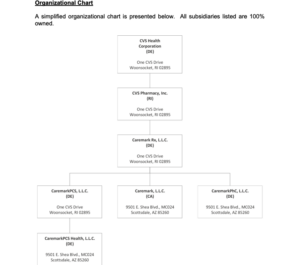
This screenshot is from a Tennessee Department of Commerce and Insurance audit, which investigated CVS. It lays out the company’s properties.
The audit contained a long list of concerns about potentially illegal practices.
They all boil down to one recurring complaint: The PBM that CVS owns negotiated higher payments for affiliated pharmacies than independent ones.
It’s all pretty technical. Here are a couple of examples.
Insurers pay a fee on top of drug prices to pay for pharmacy services. These are called “dispensing fees.” The audit accuses CVS and its PBM of paying small independent pharmacies, especially in rural areas, at lower rates than the law allows.
In other cases, the PBM was getting insurers to pay higher prices for specific medications. For several schizophrenia meds, CVS-affiliated pharmacies were getting paid five times more than other pharmacies.
Explaining how this affects patients is difficult. Many of the decisions that affect consumers directly are made by insurance companies. But critics say the insurance companies are being led by PBMs and their negotiations.
During a recent legislative hearing, an oncologist and several pharmacists gave this example. An insurer says it will cover a drug, but only if you get it through a specific mail-order pharmacy. That means waiting weeks for the meds, even if a local pharmacy has doses sitting on the shelf.
The critics are especially vocal about the issue when the PBM involved, the mail-order pharmacy and the patient’s insurer are all owned by the same company.
What does this bill mean for CVS?
Depends who you ask.
Throughout the hearing, CVS employees testified the measure would make them lose their jobs, and that their patients would lose access to care. In press materials sent to news outlets, other clinicians say the same thing.
When CVS executives describe the bill, they don’t say it’s an order to divest in the PBM. They say, “SB 2040 seeks to ban CVS Health from conducting pharmacy operations in Tennessee.”
On Friday afternoon, the CVS team released a letter from Joyner, the CEO, sent to the General Assembly. It offers the deepest look at why the company argues this policy would force the chain to close pharmacies.
“In Tennessee, as in most states, Caremark (the PBM) doesn’t only contract with CVS Pharmacy, but with other chains, grocers, independents, almost anywhere people can get their medication,” the letter reads in part. “It is simply not feasible to cease a nationwide network in one state. That leaves me with only one way to comply with this legislation, ending pharmacy operations in Tennessee.”
Response in the general assembly
Lawmakers on both sides of the aisle aren’t buying it.
“The bill does not close pharmacies,” Harshbarger, the Senate author, said during a hearing. “Divestment does not equal closure.”
Haile grilled the CVS representatives when they said closure would be inevitable if the bill passed.
“So are you telling me … that you had rather close the stores than diversify those stores to another owner?”
None of the representatives were executives who could speak to business decisions.
On the House side, Rep. Aftyn Behn has been posting about the bill on social media.
:A bunch of Tennesseans, including people I love, are getting played right now by CVS,” she said in one video. “The Fair RX act is really about breaking up monopoly power in our prescription drug system.”
On the Senate Health Committee, Sen. Becky Duncan Massey was the sole vote against the Fair RX Act.
“We have a CVS distribution center in Knox County that I recently visited,” she said. “It has about 500 employees. It actually distributes to almost the whole Eastern seaboard, 11 states. And I have trouble voting against my distribution center, regardless of everything else.”
Concerns about price hikes for the state
State officials testified this week that the legislation could cost the state tens of millions of dollars — especially within TennCare. They focused on the discounts and lower prices that CVS can offer, and estimated the price hikes they’d pay if CVS closed all of its locations.
“State benefit plans covering state employees, teachers and local government workers would see a 2.5% cost increase, or $29M, in state pharmacy plan costs if the bill becomes law, because there would be fewer in-network pharmacies,” CVS summarized in a press release. “TennCare acknowledged the state’s expanded Medicaid program would see higher costs as well, with projections as high as $66M.”
But there was some disagreement on that front too.
Bojan Savic is the executive director of the fiscal review committee, which puts together the fiscal impact statements lawmakers use to assess legislation. The fiscal note for SB 2040 held very different projections from the ones offered by the TennCare director and other executive branch officials.
“I would say the main reason for the disagreement is behind the assumption that pharmacies will close if they are PBM-owned pharmacies — that they will simply shut down in the state,” he said during a legislative hearing. “The assumption in the fiscal note is that these pharmacies have options to restructure, divest, and that they remain in operation.”
Copyright 2026 WPLN News


